
What is a Dishwasher?
A dishwasher is an automated kitchen appliance engineered to clean, rinse, and dry dishes, cookware, and cutlery using controlled water pressure, detergent chemistry, and thermal cycles. In the Indian market, major brands like Voltas Beko, Bosch, LG, IFB, Siemens, and Faber offer dishwashers designed for stainless steel, glassware, and various kitchen utensils common in Indian households. Modern dishwashers utilize spray arms, heating elements, filtration systems, and detergent dosing to achieve consistent and hygienic cleaning output.
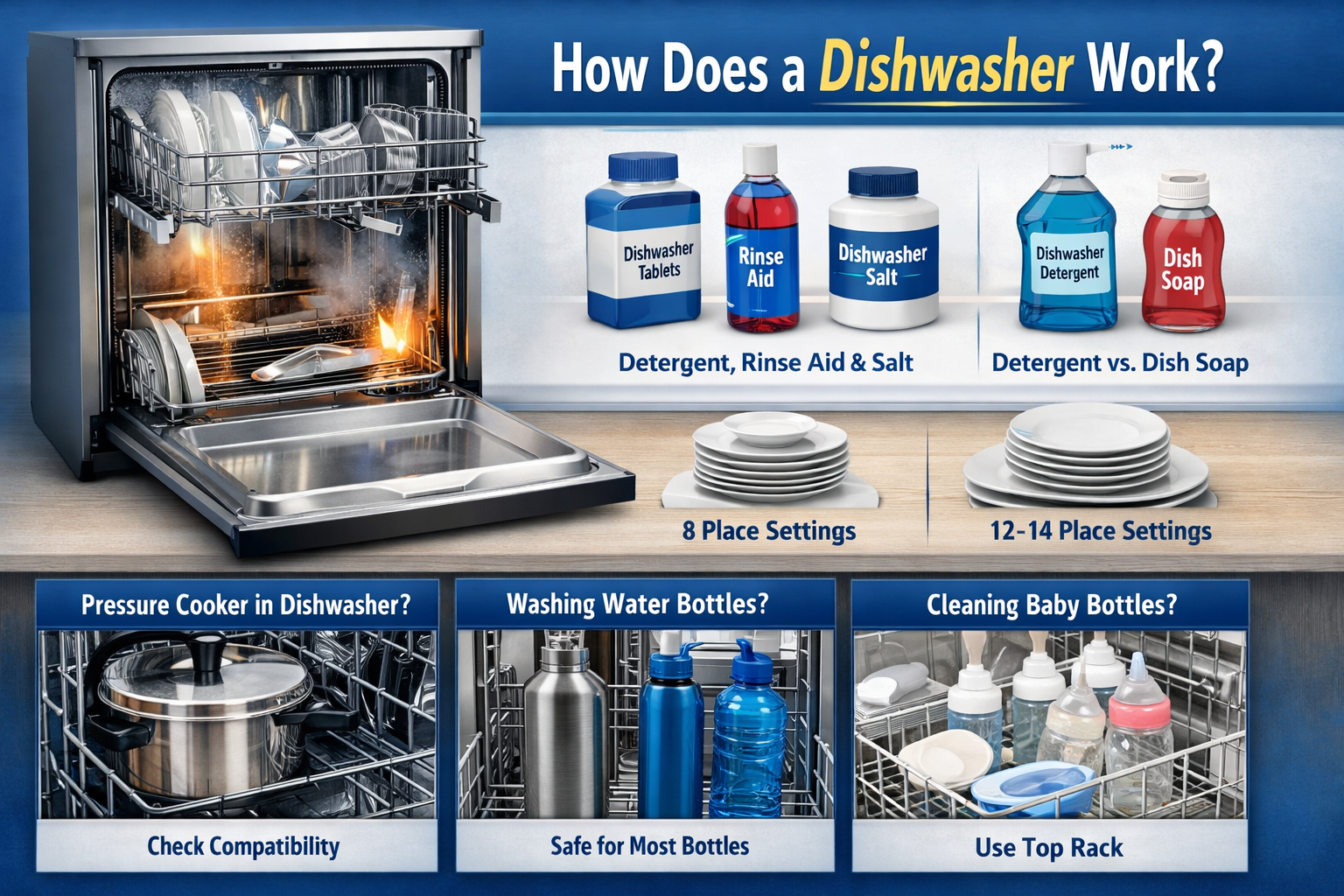
What all Items are Required for a Dishwasher (Salt, Rinse Aid, Detergent)
A fully functional dishwasher ecosystem typically requires three consumables:
- Dishwasher Detergent (tablet, powder, or gel)
- Dishwasher Salt
- Rinse Aid
These materials operate in separate domains: detergent for cleaning, salt for calcium/magnesium management, and rinse aid for surface-level moisture behavior.
What is Rinse Aid?
Rinse aid is a surfactant-based additive that optimizes the final rinse stage. It lowers the surface tension of water, reducing droplet formation and enabling sheets of water to roll off glass, steel, and ceramic surfaces. This leads to improved drying performance and reduction of water spots or streaking on reflective surfaces.
What is Salt?
Dishwasher salt is a coarse granular sodium chloride variant that regenerates the dishwasher’s built-in ion-exchange water softening system. In regions with hard water (high calcium and magnesium concentration), dishwasher salt prevents scale deposition, enhances detergent efficiency, and protects heating elements and spray nozzles from mineral accumulation. Regular table salt must not be used due to iodine additives and fine texture, which can interfere with the softener mechanism.
How is Dishwasher Detergent Different from Daily Dishwashing Soaps?
Dishwasher detergent is formulated for mechanical washing and high-temperature spray cycles. Its chemistry relies on enzymes, oxygen-based bleaching agents, and alkaline builders designed to break down starches, proteins, and grease without manual scrubbing. It produces negligible foam because foam disrupts pump pressure and reduces cleaning efficiency in closed-circuit spray systems.
Daily hand-wash dishwashing liquids are surfactant-rich and foam-intensive. They are optimized for manual agitation, lower temperatures, and skin contact safety. High-foam detergents cannot be used in dishwashers because foam obstructs sensor feedback, reduces spray arm rotation, and can trigger leakage alarms.
FAQs
How to Understand Number of Plates and Usage?
Dishwashers are rated by “place settings”, which represent standardized sets of dishes including plates, bowls, cutlery, and glasses. Common configurations include 8, 12, 13, and 14 place settings. For Indian usage, manufacturers often provide usage mapping:
- 8 place settings: suitable for 2–3 members
- 12–14 place settings: suitable for 4–6 members
The loading pattern determines water coverage efficiency and thermal performance. Utensil geometry should not obstruct spray arms, and overlapping surfaces should be avoided to ensure full jet exposure.
Can You Wash Pressure Cooker in a Dishwasher?
Aluminium pressure cookers may discolor due to alkaline detergents and thermal cycles. Stainless steel pressure cookers are typically compatible, but rubber gaskets and safety valves must be removed from washing zones to avoid degradation from heat and detergent exposure. Always position cookers facing downward for proper drainage and verify manufacturer guidance for material-specific limitations.
Can You Wash Water Bottles in a Dishwasher?
Most stainless-steel and BPA-free plastic water bottles are structurally compatible with dishwasher cycles. The cap assemblies should be separated to prevent moisture entrapment. Insulated double-wall bottles must be checked against manufacturer instructions, as trapped moisture in insulation voids can impact thermal performance.
Can Baby Bottles be Washed?
Baby bottles, nipples, and accessories made from BPA-free plastics or food-grade silicone may be washed in a dishwasher. They should be placed on the upper rack to avoid direct thermal proximity to heating elements. Sterilization claims should not be made unless the appliance supports dedicated sanitization cycles with validated temperature profiles.